Showing posts with label cancer. Show all posts

25 Jun 2017

Racing for Life

Me, my siblings Eliza, Jess, Sooz and George and my sister-in-law Rosie are doing Race for Life 5k at Peterborough on Sunday in memory of our Mum.

My mum never saw an oncologist. She wouldn't go. She knew there was nothing they could do, so she wouldn't go. It made no difference. But it meant we were never offered genetic counselling or testing to find out if we carry the genes that make some women more susceptible to ovarian cancer. We don't even know for certain where Mum's primary cancer site was; the histology was not clear. Having endometriosis means I have an increased risk of ovarian cancer anyway, but my gynaecologist is reluctant to test me for the genetic fault on the NHS until someone else in my family gets it. As the oldest ovary-containing child of my mother, the test case is me.

My mum's type of cancer was unusual and incurable. Even if she had been diagnosed two years before, when we suspect it started, she would have been dead within five years. And she would have hated that. She would have hated the tests and the treatments, the desperation and the fear and the hope that led nowhere. I am glad she didn't know. As we come up to the anniversary of her diagnosis, I am glad that we didn't know.

But now we know.

We are not just racing for life. We are racing for hope. Hope for ourselves. Hope for others. Mum has not been the only cancer death close to us in the last year.

So we run (/walk) the Race for Life, and we hope that we live to be a hundred. We will walk around a field on a Sunday morning in the hope that we never have to go through this again. We will walk, we will sweat, we will giggle, we will pant because we are hopelessly unfit, and we will hope that if it happens to us, they will be able to help.

As of today, we have collectively raised £815 (+£167.50 gift aid) and we are so grateful. That's the cost of two MRI scans. The cost of two colposcopies to diagnose cervical cancer. Four prostate biopsies. Eight sessions of chemotherapy.

It's a lot. It's not a lot.

Please donate if you can, if not to us, then to someone who else who is racing or directly to Cancer Research.

August 2016 <3

3 Jun 2017

Stewart Jackson: Redux

It's election time once more! Last time, despite my pleas, Peterborough foolishly elected Stewart Jackson as MP once more by a scant 1950 votes. And, as his leaflet dropped on our doormat the other day, let's take a look at the Life and Lies of Stewart Jackson.

So, the front page. Stewart Jackson stands with Theresa May, as you'd expect really, considering he's a Tory. He's hardly going to claim he hates the bitch and would make a much better PM. There's also a photo of him beaming in front of Peterborough guildhall and supporting a bee protection charity. That's ironic since he's consistently voted against climate change protection measures.

Within the leaflet, he marks out the work he's done for the area, like blocking the solar energy farm that was going to be built on Newborough fen; raising a petition about Werrington freight line  - he doesn't mention it submitted before GE2015, went unanswered, and the plans went to the secretary of state three months ago - and trying to improve the A47, which is underway, notably with the FUCKING AWFUL traffic lights at Wansford A1 junction. Such a trooper. In fairness to Stewart Jackson, he does write to the cabinet with questions pertaining to Peterborough (most of which already have answers available in the public domain), and voted in around 85% of all votes. He pushed for Brexit, which is no surprise, and he's even curbed his expenses a little. He's very proud of Peterborough's low unemployment rates. He also claims that the NHS is his top local priority, which is an absolute joke considering his voting history.

His voting record remains a catalogue of misery for anyone who isn't an older, healthy, white, heterosexual, salaried, homeowning British citizen.
He has consistently voted against gay rights, race laws, benefits being raised in line with inflation, and increasing jobs for young people. He has voted for the bedroom tax, for restricting disability benefit, for restricting disability benefit to those who have been disabled from birth/youth. He has voted against limiting letting fees for tenants. He has voted against people with cancer receiving extended ESA, He voted for the tuition fees raise, for the academy system, and for the various bills undermining the NHS. He has voted against ID cards, but for mass data retention (the Snooper's charter). He voted against a right to remain for EU citizens. He has voted against special provision for military families in the welfare system. He has voted against slowing the rise of rail fares. He has voted against nationalisation of public transport.
Of course he has, he's a Tory.


The rest of the leaflet is given over to the words of The Great Leader Theresa May. Theresa swears she has set out a clear approach to Brexit, which...has she? Really? She says she has a strong negotiating hand. The Tories have been openly mocked by the rest of the EU and Theresa May has demonstrated that she couldn't successfully negotiate a child's bedtime. We have nothing to negotiate with, except tax haven status,
And then, in a rehash of the last election, we are told our election choice is Strong and Stable Leadership in the National Interest OR A COALITION OF CHAOS with Jeremy Corbyn and Tim Farron. DO YOU MEAN TO TELL ME, CONSERVATIVES, THAT A COALITION GOVERNMENT WITH THE LIB DEMS IS A BAD IDEA???

The leaflet then tells us that Trump winning was a shock, even though Theresa May fell over herself to rush over there and hold his grubby, orange mitt. Brexit was a shock, even though the Tories definitely wanted it and it's gonna be amazing, honest guv. And Corbyn winning two leadership elections was a shock.

Maybe Britain is fed up of your lying bullshit about caring, Theresa. Maybe hardworking British families, who are also apparently irresponsible benefit scroungers, have had enough of your shit, of your punishing the economically weak for the faults of the strong, of being told if they would JUST WORK HARDER, they too could be RICH. Maybe normal British people fancy someone with a bit of integrity, someone who is decent, who inspires faith in the politically inactive. Someone who hasn't promised on national TV to NUKE THE WORLD, you fucking bloodthirsty maniac. Maybe the national debt going from five hundred billion pounds under Gordon Brown to a staggering ONE THOUSAND SEVEN HUNDRED AND THIRTY BILLION POUNDS in just SEVEN YEARS of Conservative government doesn't inspire a lot of confidence about your FUCKING ECONOMIC NOUS, which has always been the Tory selling point.

People are dying under this government, unnecessarily. The NHS is being stealthily dismantled, as is the social care contract. We go headlong into Brexit, fronted by a vindictive racist who couldn't lead herself out of a paper bag; who thinks you will vote Tory because you think they're a safe pair of hands. They aren't.


All voting information from They Work For You. Economic information from UK Public Spending. Leaflet published by Matthew Dalton on behalf of Stewart Jackson. Vitriol my own. 

18 Oct 2016

Dying

When I was working, we had patients dying all the time. They used to die in threes, or so it seemed, of all manner of causes, at all ages. We had a list of palliative care patients and they usually were on there because they had been issued with a DS1500. A DS1500 is a form that says you will die within a year or six months. It is a death sentence, created by the government to give you fast access to disability funds, and to pension payouts. I had known some of these patients for years. One had had a cancer in the 1980s as a youth, and been left with suppurating radiotherapy burns which still needed dressing three times a week after twenty years.I had seen that patient three times a week, because the appointments coincided with my shifts, for several years when the cancer came back and they were gone in weeks. The weird thing about working in a GP surgery is that you get to know these patients really well, until they are dying and then they drop off the radar. They become restricted to home visits and fasttracked phone requests for medication and dire oncology letters. The terminal rarely visit the GP surgery. In eight years, nobody died there. We had a birth. We had bloody emergencies in the waiting room. But nobody died. One person had a heart attack and died an hour later in A+E but I never saw anyone die in front of me. Death became everyday, something we all sympathised and empathised with, but the nearest I came to the reality of it was the grief stricken relatives in the weeks afterwards. It changed my perspective on what 'old' was, partly because I was but a youth myself, but partly because teenagers were cut down alongside the very elderly. The idea of death occurring in generational order vanished as I saw grieving spouses and parents, young grieving children, grieving grandparents. Grief doesn't give too much thought about how old the dead are, only about what is lost, be that potential or memories or both.
I became obsessed with death, surrounding myself with literature on pathology, interested in the myriad ways the body could fail, and from there, an interest in more generalised anatomy. But I never saw anyone die.

My first experience of dying predates this, of course. My friend Daisy Fuller. She died in 1995. She was ten years old. She was ten days younger than me. She had leukaemia and hers was the first funeral I ever went to. I was in the choir, and the church was packed and we sang. I don't remember what we sang. I don't remember seeing her coffin. I still visit her grave whenever I'm in the area.
Then my baby brother. He would be seventeen now. He was very teeny tiny. We had his coffin the house the night before the funeral, and it was the only time he ever came home. His name was Thomas. We don't forget him. He's buried just across from Daisy.
Then my grandparents. I was sixteen and they died within eight weeks of each other, both of cancer. Grandad went first, suddenly it seemed to me. Granny a little after after what felt like many months of illness, but was barely eight weeks.
There have been so many others since then, those I loved, those I barely knew, those who were kind to me, helping me gather chickens as a panicking teenager and those who gave me lifts to work. But I never saw them die.

It took two months to realise Mum would really die. Two months. I was terrified when she first got ill. One Sunday in June, I went straight to her house from a day out hoping that she wouldn't be as ill as she sounded. Alas, my mum lacks the clinical signs of infection and the only indication she wasn't right was a slightly raised pulse. I thought she would be OK with antibiotics. She got worse. I sent her back to the doctors because she was afraid to take herself. I told the doctors I thought she had a bowel obstruction. They missed the tumours. They sent her home with another pack of augmentin.
And then she went on holiday, and her bowel burst and poisoned her and I still don't know how she survived. My dad rang me and told me her bowel had burst and she was going to surgery and I had faith, faith in medicine, that she would survive and she would be OK and this was horrible but also the best thing because she would be OK. I told my siblings the same. This was unhappy but at the same time, survivable. She was in the best place, and it was unfortunate that the best place was miles away, but she was safe.
Later that night, Dad told me what the surgeon had told him, and I travelled to be with him while they told her. I still had hope. I still thought it would be OK. They can do so much for cancer these days. They can do so much. We went to see her in ICU, and she was so pleased to see us, and me and my dad sat with her while the surgeon told her what he had found. When he said they wouldn't have operated if they had known, I thought my last spark of hope died. I was wrong. Metastatic adenocarcinoma of unknown primary. Multiple metastases. Circulatory shock. She recovered at an astonishing rate, and was able to come back to Peterborough.
The surgeons in Peterborough were optimistic that they would get her fit for chemo, despite Mum saying over and over that she didn't want it. And then they couldn't give it anymore, and I think that was a small relief to Mum because she hates and fears hospitals. When she was first discharged, I felt so absolutely responsible, the way you do when you go home with your firstborn. Responsible for keeping her alive, for keeping her comfortable, for looking after her.
I don't feel like that now. I realised after a particularly bad weekend that, no matter what I did, I would not ever be able to save her. I already knew I couldn't, but knowing objectively that you can't, and accepting it are two totally different things. Mum's like the knight in Monty Python And The Holy Grail, armless and legless but still going. But the reality that I would have to watch her die was slow to come, and hit me with terrifying force. I lost my grip and I fell down a hole for three days, and then I came back up and I felt more at peace.

She's still here. She's STILL HERE. She is still alive, and she can sometimes talk though she sometimes can't, but she can give me a kiss and I can stroke her hair and moisturise her and she is still here. She is still Mummy for a little bit longer. I have stopped expecting her death with every silence, stopped panicking at every text, stopped thinking ahead, stopped trying to save her, stopped thinking it is my responsibility to save her and stopped feeling guilty for Not Doing the thousands of things that would have made no difference.

We don't know when she will die. We have never known when she will die. She has always been certain that she does not want to know. She does not want us to know. She has known too many people given six months who have had years and too many given years who have had weeks. She does not wish to labour under sentence of death. There's a strange feeling of being adrift because Mum no longer goes to hospital. Who is in charge? Does it really matter? She is in charge. She knows what she wants. She is mighty in the face of death. We love her so, so much. We just want to keep her.


She's still here.

10 Oct 2016

First, Smash Your Egg

Jon Snow has just written cancer on an egg, and smashed it with a cricket bat. This is how Channel 4 thinks you should stand up to cancer.

Smashing an egg doesn't reverse the mutations that lead to cancer.
Smashing an egg doesn't make cancer easier to spot.
Smashing an egg doesn't make money for cancer research.
Smashing an egg doesn't make people sign up for blood and bone marrow donation.
Smashing an egg doesn't do anything at all for Stage IV cancer.
(Stage IV cancer is "Sorry Mrs Hudson, there's nothing we can do" cancer.)
Smashing an egg is probably not going to make anyone frustrated with cancer feel better. It's a fucking egg. Smash up the china section of John Lewis after scrawling 'cancer' all over the plates, and you might feel a bit less frustrated*.
Smashing an egg doesn't do anything except get Jon Snow's face all over Twitter.
To quote, you know nothing Jon Snow.

Instead, take your egg. Boil it. When the water comes to the boil, put your toast in. When the toast pops, take your egg out, decapitate it, butter your toast thickly, sprinkle with salt and eat. That's a good and useful thing to do with an egg.

Perhaps I'm being sensitive. Mum's still dying. Who knew dying could be so difficult? What nobody tells you on these cancer adverts, on these smashed eggs, on these tits-out-for-cancer memes is that dying of cancer is hard.
My mum has lost around five stone, maybe more. My mum can't stay awake. My mum is in pain, despite strong opiates. My mum is chronically dehydrated. My mum can barely speak. My mum hurts.
My mum is so glad to be alive.
Three months ago, my mum was still at work.

Cancer is vicious. Cancer hurts. People you know are dying of it, and they maybe don't even know they have it. Cancer is terrifying. Cancer is not a smashed egg on the floor, looking for clicks and shares.

If you would like to do something genuinely useful for cancer, please consider:

Donating blood. Blood products are so useful in almost all cancer care.
Donating bone marrow. Some types of blood cancer can only be treated by bone marrow transplants. You won't be asked to donate unless you're a tissue match, so it's only spitting in a cup.
Donating to Macmillan in my mum's name. Macmillan nurses offer a lot of practical and emotional support, and also coordinate cancer care.
Donating to SecondHope who are researching treatment for Stage IV breast cancer
If you are in Lincolnshire, donating to St Barnabas Hospice who are helping Mum stay at home.
Donating to Cancer Research UK who have coordinated the Stand Up To Cancer campaign and for whom the initial egg was smashed in the first place.

Your money makes a difference. Cancer doesn't agree to give you a freebie cure in exchange for likes and shares.

* Please don't. Cancer doesn't get you out of criminal vandalism, alas.

24 Sept 2016

Cancer

Cancer is a fight. A battle. A conflict between the brave victim and the merciless disease. Cancer is a war to be won, or lost.

Cancer is often depicted as some insidious evil, worming its way inside, unseen. Like a horror film, the monster that crawls inside in the dead of night to burst out when least expected for shock value. Cancer, however, comes from within.

So what is cancer? Cancer is a vast collection of diseases that get put under the same umbrella because they all stem from the same root cause - some cells in the body go wrong.
You have a multitude of different cells in your body, and the majority multiply by splitting into two perfect copies of the original. The scope for this simple, taken for granted act to go wrong is enormous - one wrong protein in your nucleus and you've got something your body didn't plan for. Most of the time you, immune system will spot the error and kill the imposter. These irregular splits happen thousands of times a day and you're none the wiser.
Unless. Unless. Unless.
Mutations, for that is what they are called, build up over time. A slightly irregular cell doesn't get blasted by your immune system, it splits into two more slightly irregular cells, and so on and so on. This is why cancer becomes far more common with age - mutations have been building one on top of the other for years and years, and one day, something shifts and it goes from unusual cell patterns to a tumour.
Some substances make these mutations more likely. Smoking, drinking a lot, eating too much red meat, eating insufficent fibre, asbestos, etc etc. You've heard of everything causing cancer, I'm sure, and in some cases they're justified.
Some people have a genetic susceptibility to cancer. They have a gene fault that makes either the irregular cells as standard or that makes the irregular cells multiply far faster than normal. This is why people who have never smoked get lung cancer, and why people who have always smoked don't. This is why young people suddenly get cancer for no apparent reason. Genetic mutations in your DNA can be inherited (like the BRCA gene for breast and ovarian cancer) or you can develop them in utero. Perhaps cancer is simply stamped on our genetic template long before we are people.

There are only three treatments for cancer, and they're both simple and terribly complicated. You can cut a cancer out, provided it hasn't spread. You can burn a cancerous tumour away. You can poison your body, to kill the cancerous cells. A tumour removal can be a ten minute minor operation for a skin cancer, or it can be an intricate hours-long operation on your brain. There are as many types of chemotherapy as there are cancers, and some are designed to cure and some merely to buy time, and chemotherapy in itself is dangerous and often difficult. Radiotherapy is most useful in tumours that are difficult to get to, to burn away what couldn't be cut away. There are other treatments, particularly in reproductive cancers that are heavily influenced by hormones, but these are the big three.
We speak of curing cancer. We talk of wanting a day where nobody dies of cancer, where everyone can be treated and live forever. Cancer has existed as long as life has. It is the paradox, that what gives us life, this constant replication of cells, can kill us. The longer lifespan our species has, the more likely cancer becomes. We speak of hope, of treatment, of cure.

But we don't speak of what happens when there is no cure. We speak of those who have died, but not those who are dying. It hurts too much. It is difficult to admit there is nothing to be done. Cancer is always framed as this eternal battle between the darkness and the light, and when no cure or treatment is available, it is concealed, somehow wrong. Failing. Losing. Giving up. There must be SOMETHING that can be done? Surely, in this day and age, there is SOMETHING?

The nature of medical intervention changes. There are no treatment plans made, only plans for comfort. Suddenly home is a hospital - a hospital bed in the dining room, Class A drugs through the arm, syringe drivers under the stairs, medication that would fell an ox when previously she wouldn't take paracetamol for a headache.

My mum hasn't given up, even though we have known there would be very limited scope for treatment from the very start. She is doing everything she can to stay well, to recover from setbacks and to live properly through this. Our family cluster around. Those who can't ask for updates, but there are no updates people want to hear. It becomes harder to talk about, because we can't put the discourse in terms of What's Next treatment-wise. Sometimes, I wish she could have chemo just so I had something to tell people when they ask how she is. She's planned her funeral to the last detail, but what happens after that is the Mordor in the distance. We, her children, are attacked by grief at unpredictable times. Grief and rage and unfocused pain, but love and laughter, black humour and togetherness. Dying isn't the same as death. We can't imagine her absence while she is still so alive. We live in stasis, a bizarre limbo where there is no hope, only now. Only today.


I write these blogs partly as release, but also to inform. We are collecting for Macmillan, but if you are in Lincolnshire, please also consider donating to St Barnabas Hospice whose nurses are currently looking after Mum at home.

15 Sept 2016

Life

Quality of life is difficult to define. In conversation, particularly when discussing degenerative illnesses like dementia, you often hear phrases like "I wouldn't want to live like that", sometimes to the point of being asked to be euthanised if they occur. Nobody wants to suffer. Suffering looks awful.
There are scales that are used to try and quantify what constitutes a life worth living, mainly as a way of channelling resources into palliative and end of life care. It should be noted that palliative care is any care that is intended to provide comfort rather than cure and can be offered alongside curative treatment, whereas end of life care means just what it says. Many people who are disabled or seriously ill may find that they have no quality of life according to these scales.

When discussing the theory of quality of life, what tends to be discussed is what makes people feel they are experiencing good quality lives, rather than focusing on the physical limitations they may have. These things tend to change throughout the life course, and are usually classified as hedonic (focused on immediate pleasure) and eudaimonic (focused on long term fufilment). I find my children immensely important to my quality of life in a way that my teenage sibling does not, indeed cannot. Fifteen years ago, my quality of life depended solely on my ability to be able to go out and get ratted. That is...slightly less the case now. Then you can take wider environmental concerns into accounts; things like living in a decent quality house, being able to find work, living in a low-crime area. It's difficult to have good quality of life living somewhere that makes you frightened. It's difficult to have a good quality of life if your main goal is wealth but you are poor. It's difficult to have a good quality of life is you are not able to do what you want through disability or illness.  Quality of life is a multifaceted idea that can't really be quantified. Though, sociology being what it is, they keep trying.

My mum's quality of life at the moment is objectively crap. She can't eat much. She's mainly confined to bed. She's on some hardcore pain relief. Using the various oncology ratings for quality of life, she scores very poorly. She has hospice nurses coming in to cast their knowing eye over her medication and help support my dad. She has district nurses coming too, for clinical care. It would be very easy to look at her life at the moment and sadly shake your head and sigh at how bad she must feel.

You'd be dead wrong.

She has my dad. My mum and dad have been married for almost 32 years. They weren't together long before they got married, and I daresay a few people shook their heads and muttered that it wouldn't last, but it has. They are still in love, still in tune, still in harmony.
They have seven kids. Seven! They have nearly ten grandchildren, and some of their children haven't even got started yet (we breed like Weasleys). And believe me, if our love could heal, she'd be fine.
She has her twin back, which has completed her.

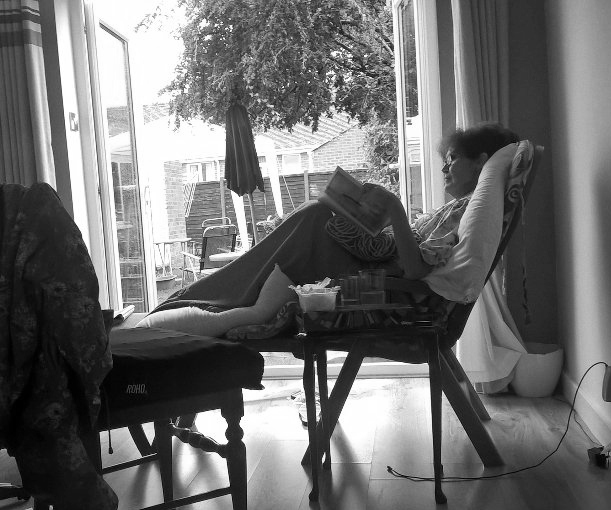
She lies in the garden, come rain or shine, with a cigarette in one hand and a book in the other, plumped up on cushions and watching the birds (or sometimes, the cat EATING the birds). When it gets dark, Dad puts on the fairy lights and she lays in her grotto and she's happy. Tired, sometimes in pain, but happy.

Cancer has stripped away most of the stresses of life. Now she is living for now, with no eye on some future anxiety, with no grief for what she cannot have. She is not afraid. She has faith in God and believes that she will go on.

The day I found out Mum had cancer, my friend (unknowingly) shared this poem on twitter and as I have watched Mum come home from hospital and take root in the garden, it becomes more and more apt.

The Peace of Wild Things by Wendell Berry

When despair grows in me
and I wake in the night at the least sound
in fear of what my life and my children's lives may be,
I go and lie down where the wood drake
rests in his beauty on the water, and the great heron feeds,
I come into the peace of wild things
who do not take their lives with forethought
of grief. I come into the presence of still water.
And I feel above me the day-blind stars
waiting for their light. For a time
I rest in the grace of the world, and am free.


30 Aug 2016

Not Normal

What is normal?
This isn't.

I got the kids' school stuff together. No stress, no panic, just sorted it out, tried it on them, put it away ready for next week. Back to school. Back to normal. Except it's not normal.

I went to see my in laws. The kids ran amok. We had a barbecue, I had a glass of wine. Everything normal. Nothing's normal.

I went to see my mum. Roast beef in the oven, nephews and nieces underfoot, sitting in the garden with Mum puffing on a cigarette, cookbook by her side. All as normal. Anything but.

The hospital runs, every week. Mum afraid, fed up, nauseous, worried, sick of waiting. The waiting. It goes on forever. We sit together, usually in a side room because Mum's too ill to sit up for long. Mum doesn't look when they do the blood tests, so I tell her when it's safe to look. I surreptitiously check her obs on the machine. Maybe I should have been a nurse. We wait for the consultant - she's lovely. We ask questions. No answers yet. They don't know where the primary site is. They are worried about the infection. No chemo til the infection's sorted. No oncology at all until the infection's sorted. They can't save Mum from the cancer. Can they even save her from the infection? We don't know. We wait for the blood tests. They do them while you wait, but it's still two hours. They return with the results. Usually bad news. Usually more worry. Usually no answers.

And yet that is when I feel most normal, most at peace. That is where I can cope. In the thick of it, surrounded by people who may not have the answers but know what they're talking about, who aren't afraid of what's happening and don't use euphemism. Where I'm with my mum, looking after my mum. Making myself feel better by making her feel better. I've always felt strangely at home in hospitals. Maybe I could have been a nurse.

I have nightmares where I fail to look after Mum, in some tiny insignificant way, but it ends up meaning everything, so I don't go to bed because I'm scared of dreaming. I see old people in the street and I resent them for being alive. I hear people bitch about their mums, and I want to scream because it's not fair. I see people being normal, being happy, being unaffected by strange crushing not-quite-grief and I wonder if I will ever feel like that again. All the peculiarities of human interaction, all the minor disagreements and trivialities of life, have lost resonance and meaning.

Mum was diagnosed a month ago today. It feels like it's been a thousand years and three hours all at once.

The only people I want to be with, household and parents aside, are my siblings because they know how this is. We all cope differently. We all feel the same. Thank god there's so many of us. Thank god we can be together.

I'm not writing for sympathy, or anything really other than to get this out. This feeling that nothing in the world feels normal anymore. Everything is wrong, like someone put a puzzle together higgeldy piggeldy and all the pieces fit but the picture doesn't make sense.

I love my mum. I wish I could keep her.

We are fundraising for Macmillan, because they are wonderful.

23 Aug 2016

If

If we acknowledged that every time we saw someone, it could be the last.
If we put that much meaning and significance into every encounter, every quick chat, every hug.
If we recognised the ubiquity and unpredictability of death.
We would all go mad.

It's not sustainable. It's something we all unconsciously reject day in day out, because it is too painful. Imagine. There would be no such thing as a quick phone call, no such thing as 'just popping in', no such thing as a nod and a smile in Tesco. Every "see you later" would become racked with meaning and significance. We would all go mad.

My mum could have easily died three and a half weeks ago. In fact, protocol dictated that is what should have happened, but thankfully Mum's surgeon decided to turn a blind eye to the shadows on the xray and save her anyway. We consider this 'extra life' that she's been granted a huge boon, and we are so grateful to the team at Scarborough Hospital for doing us that enormous service. But it is not going to last long.

The greatest thing that has come out of it is that Mum can see how much she is loved. How deeply, how extensively she is loved. How many lives she has touched, how many people adore her and admire her. Too often we leave it too late to let people know how much we love them, tearfully gathering at the graveside with regrets, wondering years later why we never took the time when we had the time. You always think you will have more time.

Mum has the privilege of experiencing her posthumous tributes while she is still here to enjoy them, and she loves it. She has stopped batting away compliments.
Meanwhile, we have the privilege of being able to concentrate all our love and care on her as she has always given it to us.

This week, we have reunited with family we haven't seen in decades, and my mum is so overwhelmingly happy. It's a strange paradox, that this awful time makes us all so happy. Sometimes, I feel as though I'm full of wet sand and I can't breathe because I'm so afraid and so upset. Mostly, I am emotional yet joyful that Mum is still here, still baffling the doctors, still joking and giving out recipes, and making enormous lasagne, still full of love, still here. Still here.

I told my older children that Granny isn't going to get better yesterday, and that was difficult. Difficult enough, but when you have to take all the calming euphemism out of it for an autistic child, more difficult. And they told me that as long as we remember her, she will never leave us. I expect they heard it on a TV show, but they're right. We continue to make memories, (which is a phrase I FUCKING HATE under normal circumstances), to take photos, to be together while we can.

I don't really have a point today except to encourage you to tell your family you love them while you can. Maybe you already do tell them. Maybe you think they already know. Maybe you don't see them as often as you'd like. Maybe you don't have the words. Just tell them. Regret is so much more painful than embarrassment.

And please donate to Macmillan if you are able and want to do something help.


14 Aug 2016

Talking About Terminal Cancer

Behold, the shitty cancer awareness memes are going round on Facebook once more. Spread awareness with a heart in your status, say people who have probably never actually had to talk to people with cancer.
Conversations are a bit strange when someone you love has terminal cancer - gawd knows what it's like for someone who HAS terminal cancer. Here's a guide on how to talk to me, but I am not representative.

1. Please don't ask how my mum is unless you want the answer.
There isn't going to be a "Yeah, she's fantastic" response. If you can't deal with being told "Same" or "worse", please don't ask. There are other things we can talk about (see point 3).

2. Please don't ask, with any degree of intensity, how I am REALLY.
I don't know how I am 99% of the time. Somewhere vaguely between euphoric she's still alive and devastated at the sheer fucking awfulness of everything. If I tell you I'm fine, it either means I don't want to talk about it, or I actually AM FINE, as BIZARRE as that might seen.

3. Cancer gets boring
You'd never have thought the idea of losing someone you adore would get dull. In the first week after Mum was diagnosed, I think I had to explain it in detail to about ten people who weren't directly affected. Not because they were being nosy; they just couldn't fathom how This Could Happen, so they wanted detail. Painstaking, surgical detail at times. Being me, I was happy to give it, but LORD IT IS HARD and then it just gets boring. This is what our new reality is, but I am still the same person and I don't just want to talk about the scary thing that's happening.

4. Please don't tell me about anyone you know (or knew) with cancer, unless it's a parent or similarly close relative.
Thanks for the info, but I guessed cancer wasn't solely restricting itself to hurting my mum. I've lost two grandparents, my best friend from when I was five, and numerous other people to cancer. I know millions of people are afflicted. I know it's shit. I know it's vicious. I know it's unpredictable. It's also not an exercise in comparison.

5. Please don't tell me about people who Miraculously Recovered.
This is so unlikely and rare that I just find it annoying rather than comforting.

6. If you don't know how to deal with it, that's fine.
Honestly. I get it. Watching sad adverts on the telly and donating to everyone on Facebook's Race For Life pages is one thing. Actually being faced with the reality is terrifying. Maybe people think I will just sob uncontrollably into their shoulder, or be cross they asked how I am, or I dunno, have a full on nervo. I don't expect answers. I don't expect to feel magically better any time soon. If you don't know how to deal with it (or me), it's probably not your job to so please don't worry about it.

7. I know you don't know what to say
Unthinkable though it seems, the shoe has been on the other foot. I've been told people are terminally ill before, and not had a clue what to say. What can you say? There's no Please Die Nicely cards in Clintons. I know it's shit. It's fine to say it's shit.

8. Please don't offer help unless you are willing to give it
I know you want to help, but there's a vast difference between saying "If there's anything I can do" and actually looking after my children for seven hours. If you can, offer specific help. Lifts. Food. Company. Babysitting. That sort of thing. Otherwise, please donate to Macmillan for us, because they offer so much practical support, and take away some of the fear.

9. Don't hate me or take it personally if I'm grumpy or quiet or reclusive or angry or anything other than shitting sunbeams
I can't predict my mood. On the day I wrote this, I cried because people were nice, cried because Christmas might be shit, cried because everything in the future might be shit, shouted at the kids, had perfectly polite conversations with strangers, jumped out of my skin because someone knocked on the door, cried some more, text people until I was too tired to, and shouted some more. I am also still capable of pissing myself laughing, being extremely dark humoured, and full of love for everyone around me. I'm still a contrary, argumentative bitch. Mum's illness is like a knife to my heart every time I remember it, but death is a massive part of the fabric of life.

I don't hate cancer. I'm not going to start sharing those "99% of people don't hate cancer but I know you're not one of them" memes on facebook. Cancer is a terrifying prospect: the word alone scares the shit out of many people, but it is also part of the joy of living. Cancer is a cellular disease that we all carry the potential to develop. Our cells divide at a rate of around 50 billion PER DAY. It is a miracle to me that it doesn't go wrong all the time. Cancer is as old as humanity. There are thousands of different types: some kill you, some barely bother you. It is shit that Mum's developed a lethal kind, but at the same time, in the lottery of life, I think (and she thinks) that she's done OK out of it. All this love for her, all these amazing memories that we continue to make, all these Actual People She Has Made. Half of me is my mum. In every one of the billions of cells in my body, half the DNA telling that cell what to do is my mum. And my mum WOULD tell every one of my cells what to do.

9 Aug 2016

Mum

This blog has been written with the full consent of both my parents. My mum would love to read any (nice) comments or messages you would like to leave, either on here or twitter/facebook.

Food is inextricably linked to both memory and comfort. What's the best thing you've ever eaten? This isn't a question where the answer is likely to be "the tasting menu at The Fat Duck" or "lunch at Le Manoir aux Quat'Saisons" (though Lord knows I wish it was). This is likely to be a question where the answer is so personal it's almost secretive. An answer that requires all the senses and memory. An answer that won't necessarily tally up to anyone else's idea of a good meal.
Christmas dinner when I was about 7 and still believed in Santa, high on the magic of the thing, eating in the dining room by candlelight as it slowly got dark, with fairy lights and people everywhere. Every Christmas dinner for that matter, especially the one when my kids gave me a round of applause afterwards, even though most of it came from Messrs Marks and Spencer.
Soft beetroot sandwiches in the old van - not like a people carrier, but a Transit with seats bolted in the back, the only thing we'd all fit in - on the way to the seaside, where more beetroot sandwiches and squash awaited.
Chips in the back of that same van. Chips that I didn't like because, for some reason, I had a mortal hatred of them until I was about 14. I used to eat monstrosities like pineapple fritters to avoid the horror of chips. On holiday, we would sing all the way back to the caravan at the tops of our lungs, full of chips and warm coke from a sandy plastic cup.
Then later, much later, a massive cheese toastie, a kitkat and a pint of tea, after a night of illicit drinking down the Wellhead.

My mum's roast beef dinner, with all the trimmings and homemade cheese sauce. A meal to revive the soul. A meal I won't get to eat many more times.

My mummy is going to die.

We all know our parents will die. We have that factual knowledge, because that is what happens. Death is the trade off for life. Everyone dies, hopefully in a generational order. It is the right way of things. We reach adulthood under the care of our parents, and then the caring reverses (eventually) and we look after our parents as they die.
But really, we all think our parents are immortal. We think we will have them with us until we are old ourselves, and being old ourselves is such a distant concept that it translates to near-immortality. We've heard the statistics. We see the Macmillan cancer adverts on TV. We know so-and-so's daughter died of cancer when she was only 15, 25, or 40. But until it happens to you, you do not think your parents will die until YOU are ready for it to happen.

My mum found out she had cancer in an unusual, and quite dramatic way, after a few weeks of illness explained away by other causes. She says she's had a good idea about it for a while, but was afraid to get it confirmed. Afraid of the tests, and the internal prodding, and waiting for the results, and the grave consultations. So, instead, she waited until all hell broke loose within and found out off her merry head on morphine in an ICU, far from home. Her official diagnosis is metastatic ovarian cancer. She prefers to simply say she's dying. We don't know how long she has left yet.
But, we will have no false hope here. No platitudes. No denial. There will be no mad dashes to America for some bizarre, unproven treatment.

What we will do is look after her. My mum has had a lot of babies. Our ages range from 37 to 15. She has an army of carers, not least my wonderful dad. The joy of a big family is that when this happens, it's not one or two of you bleakly staring at each other over a deathbed; it's a platoon of you giggling over memories, being able to take over and stop each other getting too exhausted. It's a web of support that you don't need to go and look for, with different skills and styles of care. Mum doesn't want to be in hospital, surrounded by strangers. She wants to be at home with us, so she will be.

But back to food. My mum has been cooking professionally for years, mainly in care homes but also for weddings, parties, christenings and wakes. If you've been to a family 'do, you've probably eaten Mum's sandwiches. If you haven't, then you are Missing Out. Her illness has recently meant she's stopped enjoying food, because she hasn't been able to eat. She's even stopped thinking about food.
I can't think of my mum without thinking about food. This is a woman who's most common phrase is "GET OUT OF MY TRIANGLE", meaning sink/oven/surface. A woman who once, halfway through a family quiz, fell asleep until the question "How do you make a roux?" came up.  She opened her eyes, recited the ingredients, and went straight back to sleep. She taught me how to roast a chicken, how to poach eggs properly, and how to manage a kitchen. She has been bulk catering regularly since about 1990. She gave me my own obsession with cooking books - I used to read her hideous 80s cooking magazine collection as a small - and then plundered it to read herself.

I can't eat now. It's not exactly grief because she's not dead, and we shouldn't waste our time wailing about her being dead until she actually is. It's a grief for the future that would have been, if this disease hadn't happened. It's a selfish grief for the imminent  loss of such a wealth of advice (particularly with parenting) and love and care. It's fear. It's a little disbelief because how? She's 54. I thought I might get another twenty years, at least. I can't imagine myself without her.

Let me tell you something about my mummy. She is as strong as an ox. She has given birth to eight babies (my tiny brother Thomas didn't make it) and never had pain relief - one of us weighed nearly 11lb. She has had this cancer for an unknown amount of time, long enough for it to really take hold, and carried on working full time and caring for her home and children. She has coped with her parents dying, with having all these children, with all our dramas - god there's been some dramas -with faith and humour. She has had an acute life-threatening illness and dangerous operation that would have killed less hardy people and sailed through it. She laid in her hospital bed, still very physically unwell, bitching merrily about everything, expecting my dad to be psychic, totally her normal self (aside from immediately after morphine when she started asking about Uboats and hearing tingling). She has taken this awful news on the chin, with black jokes and sorrow and love. She says she's not strong. She says she's not brave. She says she's a coward or she would have gone and got it sorted out before. She is wrong. My mum is being strong and brave and an example to us all.

Mum has requested that, if you feel inclined to do something and can afford to, that you please donate to Macmillan Cancer Support through this link. They are truly being wonderful at the moment.